









|
Venezuela in Three Charts
Three charts that show the long shadow of Maduro’s economic disaster in Venezuela.
BY IGNACIO ALBE AND
ENRIQUE MILLÁN-MEJÍA
WASHINGTON—Nicolás Maduro is out, but the economic legacy of his policies, and of Chavismo more broadly, remains. In the more than ten years he was in power, inflation soared, businesses collapsed, investment fled and withered, and the overall output of the economy fell by over two-thirds.
The Venezuelan people will feel the effects of these policies for decades. The data available, albeit limited by the regime’s international isolation and autocratic nature, leads to one conclusion: Under Maduro, Venezuela experienced one of the most dramatic economic collapses of modern history.
Below are three charts that show the depth of Venezuela’s economic collapse and the challenge ahead for the country to recover.
Under Maduro, Venezuela experienced the largest GDP per capita collapse in recent history
Yearly GDP per capita in constant terms compared to 2013 levels for all IMF countries, regions, and territories.
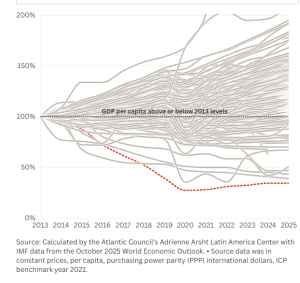
Having induced the destruction of Venezuela’s productive sectors, fueled the migration of millions, and aggressively intervened in the economy, the regime triggered what we authors calculate to be the deepest drop in GDP per capita anywhere in the world since 2013. While Venezuelans’ economic woes began under Maduro’s predecessor Hugo Chávez, the full extent of the pain came after his death in March 2013. In the decade after Maduro came to power, Venezuelans lost some two-thirds of their per capita wealth.
Social and economic development in Venezuela fell under Maduro
Change in Human Development Index score for 2023 compared to 2013.
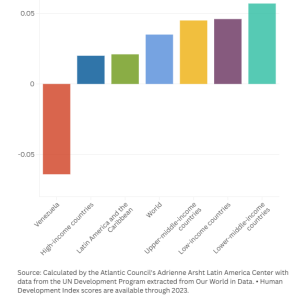
The collapse in economic activity made Venezuelans poorer, but in addition, the regime’s policies spurred the deterioration of the average Venezuelan’s overall well-being and the country’s human development. Since 2013, Venezuela’s score has fallen on the United Nations’ Human Development Index, which factors in life expectancy at birth and education, in addition to economic figures. While most of the world, especially developing countries, saw development indicators improve over the past thirteen years, Venezuela moved in the opposite direction, with major drops in indicators even beyond economic figures.
With current trends, it would take Venezuela fifty years to catch up
Venezuela’s GDP per capita relative to the Latin America and the Caribbean regional average, both historic and under different growth scenarios for Venezuela.
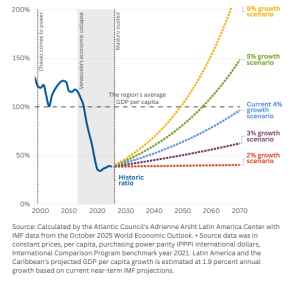
A good way to illustrate the challenge of Venezuela’s economic recovery is by comparing GDP per capita levels with those of regional peers. Venezuela has gone from far outpacing its neighbors in per capita wealth (before Chávez came to power) to becoming one of the region’s poorest countries. Making up this lost ground should be a priority for Venezuela’s future leaders, an objective that will require a monumental economic reconstruction effort and potentially one of the most significant recovery programs of this century.
Multiple scenarios exist, but for Venezuela to catch up with its neighbors and bring its income levels back up to upper-middle income status will require concerted efforts to jumpstart its energy sector, diversify its economy, attract its diaspora, boost foreign investment, and build trust with investors and Venezuelans more broadly. As the chart above shows, catching up to the region (which itself has a lot of work to do to boost its own growth) will require half a century of above-average growth rates.
Maduro and his regime’s policies have left a long shadow, but there is a path forward for the country. Venezuela’s future leaders must set the foundations for a lasting recovery for the country.
Ignacio Albe is an assistant director at the Atlantic Council’s Adrienne Arsht Latin America Center. Enrique Millán-Mejía is a senior fellow for economic development at the Atlantic Council’s Adrienne Arsht Latin America Center.
This article was originally published by the Atlantic Council’s Adrienne Arsht Latin America Center. Republished with permission.
RELATED ARTICLES
Venezuela After Maduro: A Cautionary Note for Business
Venezuela After Maduro: No Quick Recovery
Venezuela: An Ounce of Euphoria, A Ton of Uncertainty
Maria Corina Machado’s Nobel Prize Lecture
More Venezuela coverage