









|
Vaca Muerta Needs $22 Bln to Meet Targets
Oxford Economics: Lula will win re-election, USMCA uncertainty negative for Mexico banks, Venezuela poll shows Delcy would lose big-time.
BY LATINVEX STAFF
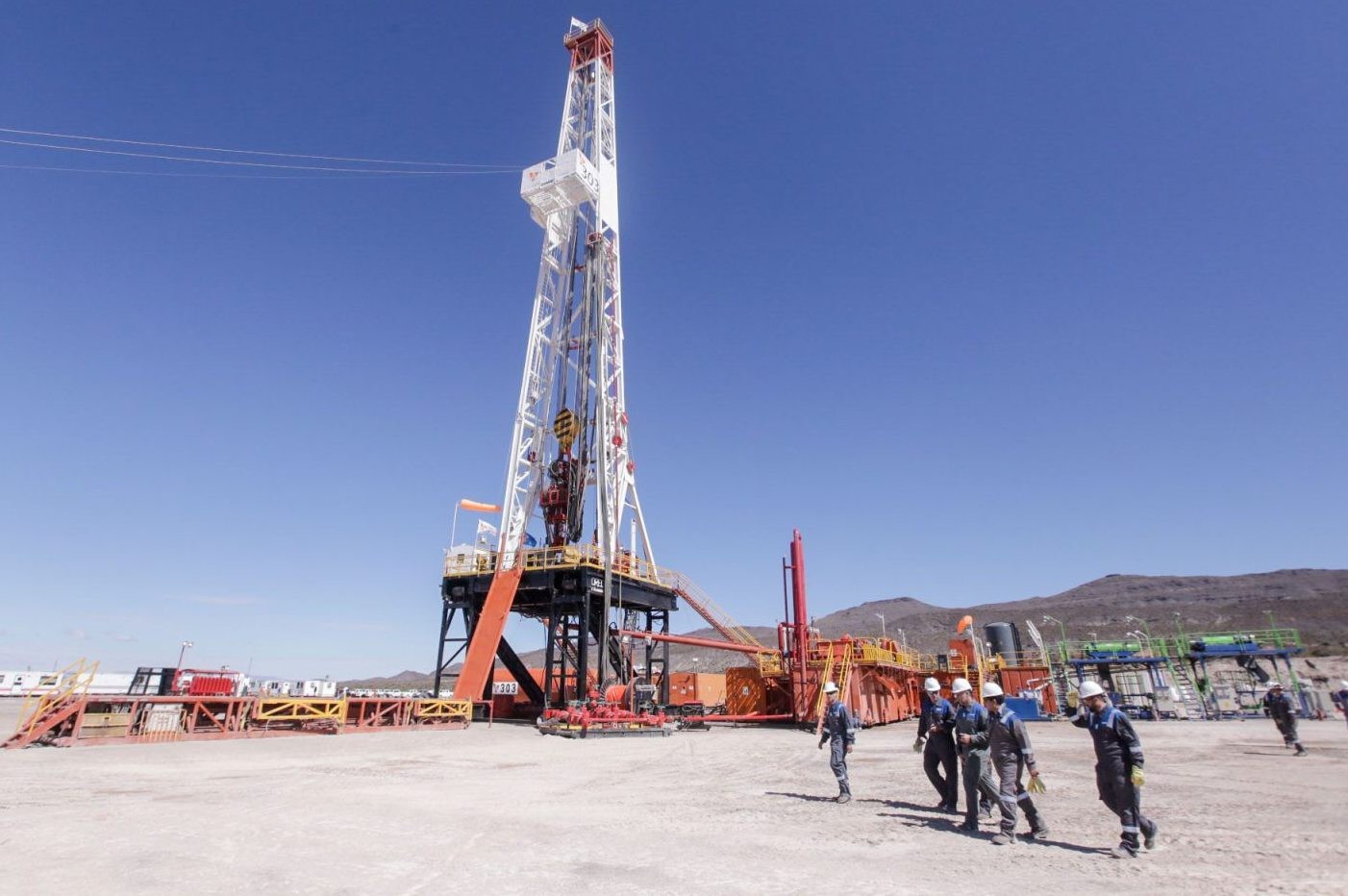
Operators in Argentina’s Vaca Muerta shale block will need to deploy an estimated $22 billion in additional capital expenditure by 2032 and drill approximately 1,000 more wells to meet planned export capacity targets, according to a new report from Wood Mackenzie.
The infrastructure challenge comes as the play’s assets undergo dramatic ownership changes, with 18 major transactions in the last two years reshaping the competitive landscape. International majors have monetized legacy positions amid improved valuations, while domestic players increasingly dominate Argentina’s most valuable unconventional resources.”
Major deals include ExxonMobil’s exit through asset sales to Pluspetrol and YPF, and Shell’s withdrawal from Argentina Liquefied Natural Gas (LNG) Phase 2. “These moves reflect international operators’ strategic realignment as they prioritize capital allocation toward core assets. Meanwhile, domestic players capitalize on their operational expertise and market knowledge,” said Maria Eugênia Ditzel, Senior Corporate Analyst at Wood Mackenzie.
Argentina’s energy landscape now reflects strong domestic control. YPF leads as the country’s dominant Exploration & Production (E&P) company while Vista emerges as a leading pure-play consolidator. Tecpetrol maintains its position as the second-largest gas producer while keeping M&A and LNG optionality open. Pampa is diversifying into oil while investing in LNG infrastructure, and Pluspetrol actively rebalances its portfolio following major acquisitions.
International participation remains selective but strategic. Continental entered Vaca Muerta via acquisitions in 2025-26, leveraging its private ownership, balance-sheet flexibility, and deep unconventional expertise. Meanwhile, Eni and ADNOC have partnered with YPF in Argentina LNG, representing a pivotal step towards monetising long-term gas resources with first LNG expected in H2 2026.
Argentina’s regulatory framework, particularly the investment incentive scheme (RIGI), has become crucial for attracting international capital. The regime offers corporate tax stability and import duty exemptions for qualifying projects. This makes it essential for large-scale international investment decisions.
“Broader participation from US shale-focused E&P companies will depend on several factors,” said Ditzel. “These include sustained fiscal and regulatory stability, demonstrated success under the RIGI framework, completion of key infrastructure, and policy continuity beyond the current administration.”
OXFORD ECONOMICS: LULA WILL WIN RE-ELECTION
Oxford Economics expects President Luiz Inacio Lula da Silva to win October’s presidential election and maintain the policy status quo, although the risks to this view are significant.
“Using our Global Economic Model, we’ve simulated extreme political outcomes and find that interest rates should still fall even in the worst case, given how tight monetary policy is, and that fiscal austerity initially raises the debt-to-GDP ratio due to lower economic growth, before hastening stabilization,” Lead Economist Felipe Camargo states.
The firm’s baseline sees Lula winning by a tight margin with a wide center-left coalition, making political pivots unlikely. Oxford Economics therefore expects his next government to focus on maintaining employment gains while supporting some degree of macroeconomic stability.
“A victory for Flavio Bolsonaro, the current opposition leader, could trigger an upside scenario if his policies address the gap in public finances,” Camargo wrote. “In this scenario, demand takes a big initial hit, but debt-to-GDP inflection and inflation targeting is achieved within three years.”
USMCA UNCERTAINTY NEGATIVE FOR MEXICAN BANKS
The continued uncertainty around renegotiations of the U.S.-Mexico-Canada (USMCA) trade agreement is putting pressure on Mexican banks, Fitch warns.
Nevertheless, the ratings agency considers that the Mexican banking sector’s solid capital and liquidity buffers, together with prudent risk management, provides headroom to absorb tariff shocks and macro uncertainty.
“Overall, banking industry asset quality metrics have shown resilience despite trade uncertainties,” Fitch says. “Fitch expects asset quality metrics to deteriorate slightly during 2026 due to slowing credit growth and sustained increases in delinquencies, mainly in consumer lending, which nonetheless should remain controlled. Mexican banks’ profitability is expected to moderate from the exceptionally strong levels seen in the past three years as credit costs rise due to higher impairments and total operating income growth decelerates.”
Risks are skewed to the downside entering 2026. Slower growth, pressure on employment and consumption, rising delinquencies in unsecured products and uncertainty around USMCA could delay investment. Nevertheless, Fitch expects any deterioration in overall banking industry performance to be contained. Policy- and trade-related uncertainties — most notably around the agreement — are considered manageable within rated banks’ current ratings, given their strong liquidity buffers and prudent risk management.
VENEZUELA POLL: OPPOSITION WOULD ROUT DELCY
While Donald Trump continues to praise Venezuela’s interim president Delcy Rodriguez and offer tepid support for opposition leader Maria Corina Machado, a nationwide poll shows Machado would rout Rodriguez if new elections were held today.
A Gold Glove Consulting survey conducted in late January 2026, the first face-to-face poll since the U.S. intervention, found that a majority (68%) think elections should be held within a year and if a national vote were held today, Machado’s opposition coalition would rout Rodríguez 67% to 25%.
“Those findings are consistent with the results of the July 2024 presidential election, as verified by electoral observers who collected and published more than 80 percent of the voting tallies,” argue Mark Feierstein and Mary Speck in an overview at the Center for Strategic and International Studies. “That election pitted Maduro against Edmundo González, a former diplomat who led the main opposition ticket after the government banned Machado from running. Although the government-aligned electoral council declared Maduro the winner, the tallies showed that he had won only 30% of the votes, compared with 67% for González.”
The poll also showed that Rodriguez is viewed unfavorably by 73%. Even more disliked is interior minister Diosdado Cabello, who still faces U.S. sanctions for drug trafficking. He holds an unfavorable rating of 83%.
NUBANK RETAINS TAB TOP RANKING
Brazilian digital bank Nubank retains the top spot in the 2026 TABInsights World’s Top 100 Digital Banks Ranking, with diversified offerings, strong customer engagement and robust financial performance.
China’s WeBank and MYBank rank second and third, while South Korea’s KakaoBank and K-Bank complete the top tier.
The ranking highlights the most successful first- and second-generation digital banks, operating independently from traditional commercial banks to provide a unique virtual customer experience.
Digital banks are entering a more structured phase after years of rapid expansion. While headline growth has moderated from early surges, profitability is improving, though returns remain uneven.
The 100 digital banks collectively held $1.4 trillion in assets, $1.1 trillion in deposits and $0.7 trillion in loans, generating approximately $60 billion in revenue by the financial year (FY) 2024.
Among them, 55 are headquartered in Asia Pacific, 26 in Europe, eight in North America, six in Latin America and five in the Middle East and Africa.
© Copyright Latinvex