









|
Latin America’s South–South Trade
Latin America’s South–South trade is increasingly a China story.
BY RAÚL GONZÁLEZ-PIETROGIOVANNA
AND ENRIQUE MILLÁN-MEJÍA
Latin American economists wrote much of the economic case for South–South cooperation. In 1949, Raúl Prebisch, the Argentine who led the UN Economic Commission for Latin America from 1950 to 1963, argued that the region sat on the periphery of the world economy, producing food and raw materials for the great industrial centers while prices moved against primary products. In 1964, he led the first UN Conference on Trade and Development, where developing countries formed the Group of 77. In 1974 the UN General Assembly adopted the Charter of Economic Rights and Duties of States that Mexico had proposed. At its July 2025 summit in Rio de Janeiro, the enlarged BRICS group (Brazil, Russia, India, China, and South Africa, joined since 2024 by Egypt, Ethiopia, Iran, Saudi Arabia, the United Arab Emirates, and Indonesia) said its members play “a pivotal role in voicing the concerns and priorities of the Global South.”
The trade data tell a narrower story. The Atlantic Council’s GeoEconomics Center reported on October 20 that developing countries now trade more with one another than with the developed world. Without Mexico, Latin America fits that finding. It sends 58 percent of its exports to developing economies, more than the 51 percent of the developing world as a whole. But 22 of those points go to China.
The South that grew is China
China, with Hong Kong and Macao, took 2 percent of Latin America’s goods trade in 2000 and 18 percent in 2024. The rest of the developing world outside the region, from India and Southeast Asia to Africa, went from 5 percent to 11 percent combined. The rest of the BRICS group has not followed. Its members other than China and Brazil take about 4 percent of the region’s trade, the same as in 2015, and India accounts for more than two-fifths of that. Africa takes about 1 percent, as it did in 2000.
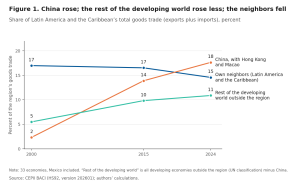
Orange is China, with Hong Kong and Macao, dark blue the region’s own neighbors, and teal the rest of the developing world. China passed the neighbors after 2015 and now takes more of the region’s trade than the rest of the developing world combined.
The neighbors are shrinking
Trade among neighbors moved the other way. Leaving aside Mexico, whose exports go overwhelmingly to the United States, the region sold 25 percent of its exports to its own neighbors in 2000 and 19 percent in 2024. No other developing region measured lost as much. Over the same years Africa’s exports to Africa rose, as did developing Asia’s exports to Asia, China aside.
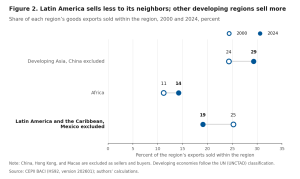
Gray dots are 2000 and blue dots 2024. Developing Asia and Africa sell more of their exports within their own regions than in 2000. Latin America and the Caribbean, leaving aside Mexico, sells less, down from 25 percent to 19 percent.
The decline shows inside the blocs. Mercosur’s four founding members did 21 percent of their trade with one another in 2000 and 11 percent in 2024, while China’s share of their trade rose from 4 percent to 24 percent. The Andean Community and the Caribbean Community also trade less among their members than in 2000, and the Pacific Alliance, founded in 2011, has barely moved trade between its members.
The exception is Central America. Its countries and the Dominican Republic trade more with one another than they did in 2000, and still more with one another than with China. Part of the reason is the US market. Their agreement with the United States lets clothing enter duty-free if its yarn and fabric come from the United States or the region, and textile inputs rose from 3 percent of their trade with one another in 2000 to 7 percent in 2024.
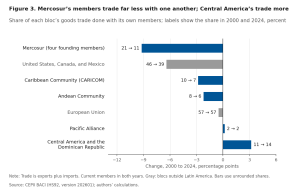
Blue bars are Latin American blocs and gray bars blocs outside the region, for reference; labels give the share of each bloc’s trade done with its own members in 2000 and 2024. Mercosur’s members now do about half as much of their trade with one another as in 2000, while Central America and the Dominican Republic do more.
Outside the region, intra-bloc trade also fell in Southeast Asia and West Africa, so this is not only a Latin American pattern. What sets the region apart is that little replaced it. Its exports to the rest of the developing world, China aside, rose from 5 percent to 11 percent, against a rise from 13 percent to 21 percent for Africa. What replaced it was China, now the center of the region’s trade with the rest of the developing world, with six of every ten dollars of it.
What shrank matters as much as how much. Nearly half of the region’s trade with its neighbors is in manufactures. Nearly nine in ten dollars it sells China are farm goods, minerals, and fuels, and nine in ten it buys from China are manufactures. That is the exchange Prebisch described, with a new center.
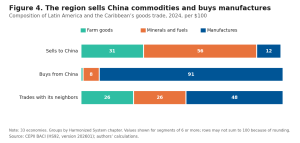
Each bar splits 100 dollars of trade into farm goods in teal, minerals and fuels in orange, and manufactures in dark blue. The region sells China commodities and buys manufactures, while its trade with its neighbors is nearly half manufactures. Minerals and fuels are mostly copper ore (20 percent of the region’s sales to China in 2024), crude oil (13 percent), iron ore (12 percent), and refined copper (3 percent).
Why now
BRICS speaks for the Global South and has enlarged twice since 2024. Since 2025, the region’s main new agreements open markets outside it. Mercosur signed an agreement with the European Free Trade Association in September 2025 and has applied its agreement with the European Union provisionally since May 1, 2026. Mexico signed a modernized agreement with the European Union on May 22, 2026. Meanwhile, trade shifted to China, including trade among Mercosur’s four founding members, who have belonged to the same trade bloc since 1991. The trade figures in this dispatch end in 2024, so the shift toward China came before US tariffs rose in 2025.
Why this matters beyond the region
Latin America’s trade agreements have been used to open markets outside the region more than to join its members. Its blocs no longer hold their members’ trade, Central America aside, and the main agreements its governments have signed since 2025 look outward. Agreements that do not hold trade among neighbors give governments less to build on when they seek supply chains, investment, and bargaining weight. For partners outside the region, including the United States, the question is less whether Latin America is turning South than which South. In trade, it is moving toward China.
Raúl González-Pietrogiovanna, is an Economic Research Consultant for the Adrienne Arsht Latin America Center of the Atlantic Council based in Mexico City.
Enrique Millán-Mejía is a Senior Fellow for Economic Development at the Adrienne Arsht Latin America Center of the Atlantic Council in Washington, D.C.
They wrote this article for Latinvex. © Copyright Latinvex