










|
Latin America Pensions Promise More Than They Deliver
Shortfall will put pressure on public finances, social stability, and region’s long-term growth.
BY RAÚL GONZÁLEZ-PIETROGIOVANNA
AND ENRIQUE MILLÁN-MEJÍA
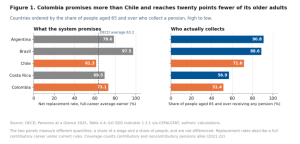
In theory, several Latin American pension systems are generous. A worker’s net replacement rate, the share of final salary a pension replaces after a full career, beats the Organization for Economic Co-operation and Development (OECD) average in four of the five systems examined here. Only Chile falls short (Figure 1).
But that headline promise depends on a condition many workers never meet: a full career in the formal labor market. In much of Latin America, that worker is the exception, not the rule. The result is a pension system that can look generous on paper while leaving millions of older adults without adequate support.
The reason is informality. Nearly half the region’s workers (46.7%) hold informal jobs. Work often comes with no payroll attached: self-employed, paid in cash, or with firms that never register the worker. Nothing is deducted, so nothing is contributed, and the pension formula counts those months as zero.
Formal and informal work are not two separate populations. They are often two phases that workers move between. The Inter-American Development Bank (IDB) measures contribution density, or the share of a working life actually paid into the pension system. That figure is 62% in Chile and 25% in Colombia. A pension built for lifelong contributors but funded only a quarter of the time is a promise most workers will never reach.
The pandemic showed this at continental scale. The World Bank estimates that Latin America’s economy contracted by 6.9% in 2020, a deeper fall than any other region and more than twice the global average. The damage did not land evenly. The International Labor Organization estimated that in the first month of the crisis, informal workers’ earnings would fall 60% worldwide—and by 81% in Africa and Latin America, the steepest fall of any region. A year of lost earnings can also become a year of zeros in a contribution record, and those missing contributions do not come back.
Coverage is the number that matters
The true test of a pension system is not what the statute promises, but who collects. Two different kinds of pensions are counted. One is contributory: workers’ pay in from a formal job and draw benefits later. The other is non-contributory: the state pays a basic amount to people who never paid into the system. Countries that run both systems reach far more older adults.
When you count everyone past retirement age who receives either type of pension, the order changes. Colombia promises more than Chile but reaches twenty points fewer of its older adults. Chile added a guaranteed pension precisely because its old system left too many people behind.
Coverage, not the headline rate, helps determine whether an older person in Latin America falls into poverty. Brazil is the clearest case. Among Brazilians over sixty, poverty is 8% on the World Bank’s international line. Without pensions, it would be 52% The math the pension promise ignores
Everything so far is a matter of shares. Demography turns it into a matter of headcount. If coverage stays where it is, a much larger older population will leave many more people without pensions. The gap is widening for two reasons.
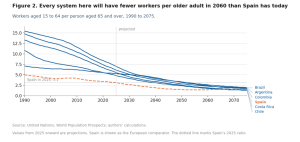
First, the region is aging faster than almost anywhere on earth. ECLAC estimates that Latin America and the Caribbean will age as much as Europe has, but in half the time. Fertility has already fallen below replacement in every country here. Chile’s fertility rate is 1.14, among the lowest in the world. The base of workers meant to fund the promise is shrinking as the number of people expecting to collect grows (Figure 2).
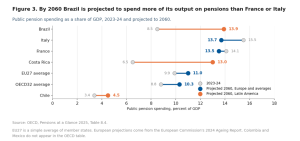
Second, the governments’ annual pensions bill is already large and rising quickly. By 2060, Brazil will spend more on pensions than France or Italy, and Costa Rica will spend more than the European Union average. Brazil reaches 13.9% of GDP and Costa Rica 13.0%, against 13.5% in France, 13.7 in Italy and 11.0 for the European Union average (Figure 3).
Yet these systems still do not cover many older adults, and much of the spending is locked into promises governments cannot easily cut. Either governments honor those promises and spend far more, crowding out other priorities, or they break them and more older adults fall into poverty. In much of the region, both risks are present at once.
The reform trap
Pension reform is one of the region’s most politically difficult issues. A high replacement rate wins votes today. The cost lands decades later, often on a successor’s watch, and workers discover the shortfall only at retirement age, when no pension arrives.
Recent reforms concede the point. Chile added a guaranteed pension on top of its private accounts. Colombia is layering a public tier over the private one. Brazil and Argentina have long topped up the older adults who never contributed. This is the more honest path. But it also admits that the original promise was never going to reach most people. That leaves two systems side by side: a generous one on paper for formal workers and a thinner one for everyone else. The first grows costlier. The second grows riskier. Neither is fully confronted.
Why this matters beyond pension policy
Pension math is slow and unforgiving. Pension systems shape fiscal stability, growth, and social pressure across Latin America and the Caribbean. A government forced to choose between paying pensions and funding everything else invests less, absorbs shocks worse, and is more likely to face fiscal and social strain. Over time, those pressures can weaken US partners, complicate investment and supply-chain resilience, and contribute to migration pressures.
The real story is that the region has written pension promises around labor markets that do not exist for many workers. The countries that handle the next decades best will be those that close the distance between what the mandate says and what the retiree receives.
A pension system’s measure is the share of older adults who actually collect. Judged that way, the region’s most generous promises are not necessarily its best systems. The test of any reform is whether, when an aging worker turns sixty-five, a pension is there.
Raúl González-Pietrogiovanna is a consultant for the Adrienne Arsht Latin America Center, based in Mexico City. He previously served as the head of productivity at the Mexican Ministry of Finance
Enrique Millán-Mejía is a senior fellow for economic development for the Atlantic Council’s Adrienne Arsht Latin America Center. He was previously a senior trade and investment counselor of the government of Colombia to the United States.
© Copyright Latinvex