








|
Latin America Infrastructure: US vs China?
Is the US prepared to bid against China for Latin America's next infrastructure concessions?
BY RAÚL GONZÁLEZ-PIETROGIOVANNA & ENRIQUE MILLÁN-MEJÍA
On October 30, Brazil’s electricity regulator will auction eight transmission concessions, with about $1.7 billion in planned investment. On November 11, Argentina opens bids for a 50-year concession on 7,594 kilometers of freight railway. Five more strategic tenders have been announced in Brazil, Chile, Colombia and Panama, three of them without a date. Each is open to the public and very competitive.
These auctions will decide the next round of Latin America’s strategic infrastructure, and if Washington wants to counter Chinese ownership rather than only block it, US development finance must be ready to back an allied bidder before the bids close.
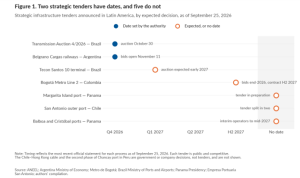
Solid blue dots are dates set by the authority, and open orange dots are expected dates or none at all. Only Brazil’s transmission auction and Argentina’s railways have a date.
How China got in
Chinese investment in Latin America is small but present in strategic concessions, and most of it is Chinese state-owned infrastructure. Since 2000, China has supplied around 6 percent of the region’s foreign direct investment, and its 2025 flow, 8.7 billion dollars, was 55 percent below the 2019 peak. State-owned enterprises account for 93 percent of Chinese infrastructure investment, and they buy natural monopolies, such as power grids, where a single network serves every customer. Both electricity distributors in metropolitan Lima are Chinese state-owned, bought from Sempra of California in 2020 and from Enel in 2024. State Grid Corporation of China serves about 54 percent of Chile’s regulated customers through CGE and Chilquinta. COSCO bought 60 percent of Chancay from a Peruvian miner and built the port north of Lima. The presence is also loudly promoted: in Panama, Chinese state-linked outlets, including the embassy, hold content-sharing and paid-insert agreements with mainstream media.
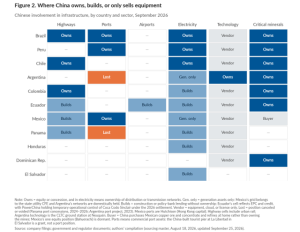
Dark blue marks ownership, mid blue construction or lending, gray equipment sales only, and orange a position lost. Ownership runs through Brazil, Peru and Chile.
Almost every one of these positions was bought from an owner that chose to sell, most often a Western one. Luz del Sur was an American utility asset until 2020, and no instrument existed to keep an allied owner in the seat. A tender is the other way in, and the one where a rival knows the date in advance.
Is Washington ready to be a partner of choice?
The National Security Strategy of November 2025 calls for a hemisphere “free of hostile foreign incursion or ownership of key assets.” In 2026, both US and Chinese governments began treating these infrastructure assets as strategic. In January, Panama’s Supreme Court voided the Hong Kong-owned concession at both ends of the Panama Canal, and Panama took over the Balboa and Cristóbal ports in February. In August, CK Hutchison filed investment-treaty arbitration, seeking more than 1.5 billion dollars. Washington restricted the visas of three Chilean officials over a proposed cable to Hong Kong, a project that has sat under review since. In June, China Southern Power Grid abandoned a bid of more than 4 billion dollars for the rest of Transelec, Chile’s main transmission company, citing valuation and the prospect of US objections.
None of those assets has passed to an American owner. The one possible US purchase in play, BlackRock and MSC’s bid for CK Hutchison’s global ports, has been stalled under Chinese regulatory review since 2025 and no longer includes Panama. Washington has shown it can block Chinese presence, but it has not shown yet that it can win tenders.
On the Chinese side, buyer, owner, operator and lender are one single actor. An American position must be assembled: a private sponsor with public money behind it. The US International Development Finance Corporation (DFC) does not bid and does not own. It lends, guarantees, and insures against political risk, and since the December 2025 reauthorization, it may hold up to 40 percent of a project’s equity. A Chinese bid is a centralized state decision. A US bid is a syndicate, or even a consortium of moving pieces.
The reauthorization raised DFC’s ceiling to $ 205 billion and created a $ 5 billion equity fund. Its record in the region points elsewhere. Of the $8.9 billion committed in the Western Hemisphere from 2020 to 2024, 69.3 percent went to finance and insurance, 10.5 percent to networks, and the median commitment ran seven years, according to the authors’ calculations from DFC data. The concessions on the calendar run 25 to 50 years. DFC recorded nothing in Chile or Argentina over those five years, and 16.8 million dollars in Peru. In high-income countries, including Chile and Panama, the law caps support at 25 percent of a project’s total cost. The ceiling was never the constraint, because DFC cannot act until a sponsor does.
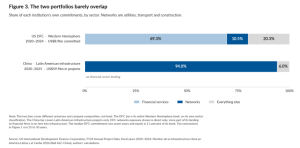
Light blue is lending to financial firms, dark blue is networks, and gray is everything else. The US agency’s book is mostly finance, and China’s infrastructure money is almost all networks. The 94 percent here is the sector share for 2020–2025. The 93 percent in the text is the state-owned share since 2005.
Who is at the bid table?
In Bogotá, three groups prequalified for Metro Line 2 in September. One is led by Xi’an Rail, a partner in the Line 1 concession. Another pairs Spain’s Sacyr with CAF. The third joins Portugal’s Mota-Engil with France’s Spie Batignolles. A third of Mota-Engil belongs to China Communications Construction Company. In Chile, China Harbor Engineering was prequalified for the San Antonio port breakwater before the tender was voided in July and split in two. COSCO has shown interest in Tecon Santos 10 in Brazil, now expected at auction in early 2027.
Only one tender has US companies near the table. In Argentina, Grupo México, a Mexican group that also runs US freight lines, has allied with Wabtec, the US rail-equipment maker, and a grain consortium including Cargill is also interested. No Chinese bidder has been named there.
The statute lets DFC back an allied sponsor. It asks DFC to prefer American companies, not to require them. Argentina’s railways are the first test: a North American bidder is in the field, the high-income cap does not apply, and DFC recorded nothing there from 2020 to 2024. Any offer has to come before bids open on November 11.
Strategic infrastructure concessions are a strong opportunity for US investors to show interest in participating more broadly by bringing their expertise to Latin America and participating in clear playing rules for those bids. Now that the DFC is better equipped to support these endeavors, the White House is instructing its ambassadors in the region to be more proactively involved in promoting US investment as the investment of choice for LAC development. This new window of concessions offers an opportunity to move from rhetoric to action as the US can become the real counterpart for economic security in the region. Only time will tell; for now, China remains present in the region, reducing its impact but still active in strategic infrastructure investment.
Raúl González-Pietrogiovanna, is an economic research consultant for the Atlantic Council´s Adrienne Arsht Latin America Center. He is based in Mexico City and previously served as Head of Productivity at the Secretary of Finance of the Government of Mexico.
Enrique Millán-Mejía is a senior fellow for economic development for the Atlantic Council’s Adrienne Arsht Latin America Center. He previously served as a senior trade and investment counselor for the government of Colombia to the United States.
They wrote this article for Latinvex. © Copyright Latinvex