









|
Latin America 2026: The Political Outlook
Elections in Brazil, Colombia and Peru and a new government in Chile.
BY JOACHIM BAMRUD
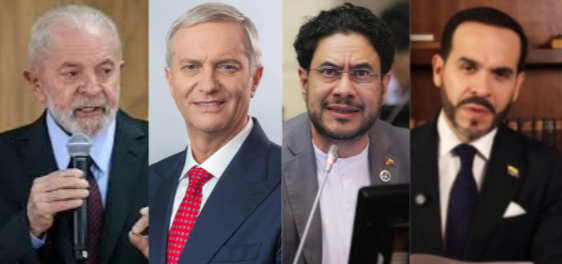
Latin America may see major political shifts this year after presidential elections in three of the region’s top six economies – Brazil, Colombia and Peru — and a change of government in the fifth-largest economy, Chile.
While Chile’s course is pretty set for a swing towards business-friendly policies with president-elect Jose Antonio Kast (who assumes in March), the political outlook in the other three South American countries remains highly uncertain.
BRAZIL
Brazil, Latin America’s largest economy, is scheduled to hold presidential and congressional elections in October.
President Luiz Inacio Lula da Silva, who is deeply unpopular among local investors, is running for re-election, but it is still unclear who will be his key rival.
“The right-wing bloc is fragmented with divisions between Bolsonaristas, traditional conservatives and institutional parties like the Centrao,” says Michael Shifter, former president of the Inter-American Dialogue and adjunct professor at Georgetown University. “So far, no single clear conservative alternative has emerged that can fully coalesce the non-Lula vote.”
Sao Paulo Governor Tarcísio de Freitas, the clear favorite in the business community, has repeatedly said he won’t run without support from former president Jair Bolsonaro and late last month said he would support Flávio Bolsonaro, the eldest son of Jair Bolsonaro in his run for the presidency.
News of the younger Bolsonaro’s candidacy rattled financial markets as investors had bet the ex-president would back a more seasoned candidate such as de Freitas, his former infrastructure minister, to head off a fourth term from Lula.
Flávio Bolsonaro is pledging a more moderate version of Bolsonarismo, vowing to take up the mantle of the elder Bolsonaro’s market-friendly reforms while distancing himself from right-wing culture wars, according to an interview he gave Reuters in December.
“Some surveys show right wing challengers like Flávio Bolsonaro or others could potentially beat Lula in a runoff when opposition votes coalesce,” Shifter says. “While fragmentation helps in the first round, runoff supporters usually consolidate behind whichever non-Lula candidate remains. Although Lula is in a relatively strong position, his re-election is far from assured.”
Much will depend on the state of the economy later in the year, whether security gets worse and becomes a more salient election issue, and if Flavio Bolsonaro can become more moderate and gain greater confidence of Brazil’s business community, he says.
“One looming question is whether Lula’s age and capacity to serve again will become an issue,” Shifter points out. “He will be 80 in October and has had some health issues in recent years.”
Brazilian investors have expressed doubts about Flávio Bolsonaro’s chances against Lula.
“Markets didn’t drop … because they dislike Flávio Bolsonaro’s platform, but because they believe—rightly—that he’d make it to a runoff, but wouldn’t beat Lula, unlike other potential candidates,” noted Andrei Spacov, chief economist at Exploritas, according to Valor Economico.
CHILE
The business community is generally bullish on the new government set to assume office on March 11.
President-elect Jose Antonio Kast has pledged more flexible labor laws, cuts to corporate taxes and less regulation. He succeeds leftist Gabriel Boric, who has been president since 2022.
In general Kast’s new cabinet has been well received. At the Ministry of Finance, Jorge Quiroz, an economist who coordinated Kast’s economic proposals during his campaign, has been named finance minister, while Francisco Pérez Mackenna, general manager of conglomerate Quiñenco, was named foreign minister and Tomas Rau (who has an economics doctorate from the University of California) was named labor minister.
However, the mining sector expressed disappointment in Kast naming one person to handle both the economic and mining portfolios, Reuters reports.
Kast last month appointed businessman Daniel Mas to lead the Ministry of Mining and the Ministry of Economy, Development and Tourism. Mas is vice president of the powerful Confederation of Production and Commerce and brings private-sector experience in construction, real estate and financial services, but lacks a mining background.
Added to that criticism, there was initial confusion about the mining ministry as Los Andes Copper and its CEO Santiago Montt had announced that Montt was going to be the new mining minister.
COLOMBIA
Colombia, Latin America’s fourth-largest economy, is scheduled to hold presidential and congressional elections in May with a potential runoff in June.
Business has suffered significantly from four years under leftist president Gustavo Petro, who has implemented inflationary policies, weakened state oil company Ecopetrol and damaged the health and pension sectors amidst a surge in insecurity as a result of his failed aim to bring “total peace” to the country by negotiating with the three leading armed groups.
Polls show that leftist Ivan Cepeda is in a tight race with far-right lawyer Abelardo de la Espriella.
“With the caveat that a lot can change — and quickly– in coming months, current polls suggest that Ivan Cepeda and Abelardo de la Espriella are headed for a second round in the Colombian presidential election,” Shifter says. “Other candidates such as Sergio Fajardo, Paloma Valencia, Claudia López, and Juan Carlos Pinzón all lag well behind with single-digit support in most surveys. At this point, there would need to be a major polling surge, strategic alliance or withdrawals or shifts in voter sentiment for there to be another candidate to seriously enter the mix.”
Cepeda would be a nightmare scenario for local and foreign investors as he is considered far more radical than Petro.
“Cepeda is a hard-core leftist, highly ideological,” Shifter says. “He is far more disciplined and consistent than Petro. He would also likely be more skillful and successful than Petro in getting through a legislative agenda of radical reform. He is particularly known for his strong stances on human rights, transitional justice, and accountability for elite groups and armed actors. Although Cepeda has a more measured political style than Petro, it is unlikely that he will be able to reduce the country’s high level of political polarization.”
Although many center-right leaders would end up supporting de la Espriella in a runoff against Cepeda, he is by no means an ideal choice for the business community,
“De la Espriella is a far-right presidential contender, known for representing high-profile, unsavory clients — including figures allied with Nicolas Maduro — as a criminal defense lawyer,” Shifter points out. “He has embraced hard-line stances on crime, national identity and traditional social values.”
Some polling suggests that many voters beyond the traditional left would be willing to support Cepeda in a binary choice against de la Espriella, he adds.
“That Cepeda would be the candidate of the Historic Pact — today Colombia’s only coherent political party — also gives him a core base of political support,” Shifter says. “At this point, it is impossible to say with certainty will be Colombia’s next president, but Cepeda definitely has a chance.”
PERU
Peru, Latin America’s sixth-largest economy, is scheduled to hold congressional and presidential elections on April 12. If no presidential candidate gets more than 50% of the vote, the two most voted candidates will face off in a second round on June 7.
Despite the vote being only two months away, there is no clear indication of who would win the first or second round.
“Polls show a fragmented field with no clear frontrunner,” Shifter points out. “What is most striking are high levels of undecided/dissatisfied voters. Rafael López Aliaga (Renovación Popular) currently leads with roughly 10–15 %, Keiko Fujimori (Fuerza Popular) is often in second place with around 7 %, but also faces very high rejection levels among voters.”
López Aliaga is a controversial businessman who served as mayor of Peruvian capital Lima from 2023 to 2025. He founded PeruRail (which serves the popular Machu Picchu route). According to media reports, he owes millions to tax agency SUNAT, but he denies that.
Keiko Fujimori is the daughter of former Peruvian president Alberto Fujimori and has led the Fuerza Popular party since 2010. She has been blamed for being a key architect behind Peru’s political crisis since 2018 when she led the move to oust Pedro Pablo Kuczynski – a favorite among investors — as president.
Other candidates like Mario Vizcarra, Carlos Álvarez, and Alfonso López Chau are grouped in the mid-single digits.
“Remarkably, roughly 40-50% of voters say they will vote blank or are undecided,” Shifter points out. “That means a huge share could swing the election later on. This is a highly uncertain presidential race. Anything can happen.”
Whoever wins the presidential elections faces a Peru that will could still suffer from political uncertainty, Shifter warns.
“In recent years, Peru has seen extreme presidential turnover,” he says. “Since 2018, Peru had seven different presidents due to impeachment, resignation, arrest, or congressional removal. Congress even invoked the constitutional mechanism of “permanent moral incapacity” repeatedly to remove sitting presidents which has weakened executive stability. In light of Peru’s recent trajectory, there is a low likelihood that the new president will be able to finish their mandate. However, if an electorally legitimate president with solid public support and skill at coalition building is elected, there is no inherent reason why they wouldn’t be able to finish their term.”
© Copyright Latinvex
RELATED ARTICLES
Latin America Capital Markets: The 2026 Outlook
Latin America 2026: The Macro Outlook