










|
AI: Not Enough for Latin America
Artificial Intelligence adoption alone will not close Latin America’s productivity gap, and improve lagged economic growth.
BY RAÚL GONZÁLEZ-PIETROGIOVANNA AND ENRIQUE MILLÁN-MEJÍA
In September 2026, at the UN General Assembly, the Inter-American Development Bank (IDB) brought together the presidents of seven regional countries, who called for a regional AI strategy. The bank also released early findings from its flagship AI report, forthcoming November 16. In 1960, Latin America and the Caribbean had $26 in income per person for every $ 100 in the United States; by 2025, it was $24. Over the same period, East Asia rose from $10 to $40, and the Middle East and North Africa increased from $17 to $35.
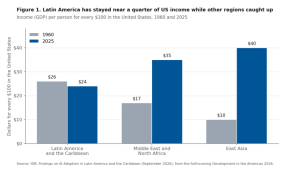
The IDB sees AI as a rare opportunity to catch up, but not an automatic one. If AI spreads widely and makes workers much more productive, the region’s economy could be 5.1% larger after a decade. If it spreads little, the gain would be 0.3%. And if the United States adopts AI quickly and the region does not, the region will fall further behind, to about $23 for every $100. The outcome depends not on access to AI, which the region already has, but on what turns it into income: skills, formal jobs, and firms that can grow.
What people use AI for
By mid-2026, about 20% of working-age adults in the region used generative AI, above the developing world as a whole (16%) but below the advanced economies (29 percent), according to Microsoft, which counts use on computers and estimates it on phones. Most of it is personal: according to OpenAI’s own research, more than 70 percent of messages sent to ChatGPT have nothing to do with work, and use is growing fastest in lower-income countries. Such use rarely shows up as output.
Much of it stands in for scarce or costly services. People ask a chatbot what they would otherwise ask a doctor they cannot reach, or a tutor or a lawyer. Health systems are further behind: a Pan American Health Organization assessment of every country in the Americas between 2016 and 2023 found that about four in ten still rely mostly on analog health data.
Where AI could raise productivity, the labor market gets in the way. AI helps most in formal, office-based jobs, but nearly half of the region’s workers, about 47%, hold informal jobs, according to the International Labor Organization (ILO). The ILO and the World Bank estimate that 8 to 14% of the region’s jobs could become more productive with generative AI, but up to half of them, some 17 million, are held back by gaps in digital access.
A country’s capacity to develop and govern AI does not predict how much its people use it once income is accounted for. Chile leads the Latin American Artificial Intelligence Index (ILIA) but ranks seventh in use. Jamaica ranks thirteenth on the index and fifth in use.
The same gap runs through the region’s digital life. Eighty-three percent of adults use the internet, against 93% in the Organization for Economic Co-operation and Development (OECD). But only 27% shop online, compared with 66%, and 26% deal with their government online, compared with 70%.
Evidence from firms points the same way. In the United States, the United Kingdom, Germany and Australia, AI spreads first to younger, more productive firms, and even there nine in ten executives report no productivity gain yet. In Mexico, research on national surveys of manufacturing and services firms found that well-managed firms do not grow as large as they do in the United States, so workers and capital stay in less productive ones. Technology that rewards productive firms will do less in an economy that keeps them small. As the IDB puts it, “AI is not plug-and-play.”
Skills decide the gains
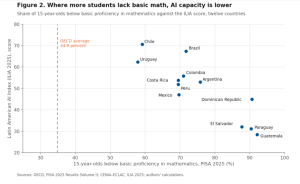
An International Monetary Fund working paper covering 86 countries estimates that the time AI saves workers is worth about 4.2% of GDP in high-income economies but only 0.6% in middle-income ones. The gap follows how ready a country is for AI more than its income. In the Program for International Student Assessment (PISA) 2025, three in four 15-year-olds in the twelve Latin American countries tested scored below basic proficiency in mathematics, against about one in three across the OECD. Countries with weaker results also rank lower on the index, and the link holds after accounting for income. AI can narrow performance gaps when people use it, but what they retain depends on what they knew beforehand.
Why this matters beyond the region
AI’s gains would concentrate where the United States is most invested. The McKinsey Global Institute estimates that AI could add about $450 billion a year to the region by 2030, and that Mexico would capture almost half. The United States is counting on Mexico and its neighbors to bring supply chains closer to home, through private investment and its International Development Finance Corporation (DFC), which committed $8.9 billion in the Western Hemisphere between 2020 and 2024. A region whose output per worker stays at a quarter of the US level is a weaker partner in that effort.
The region also builds little of the AI it uses. It produces 6.6% of world output but attracts 1.12% of global AI investment, according to the same index. Others will fill that gap. In 2025, Huawei’s cloud began promoting China’s free DeepSeek models in the region. Who finances Latin America’s AI will shape whose technology runs beneath the supply chains closest to the United States.
Three groups can change the outcome. Governments can treat foundational skills and digital public records, from health data to business registries, as the groundwork for AI rather than as separate agendas. Large firms and US buyers that anchor regional supply chains can spread management practices and AI tools to their suppliers. Development finance institutions, including the IDB and the DFC, can tie AI and connectivity lending to measurable adoption by small and midsize firms, not access alone.
The IDB calls the AI dividend “a policy choice.” Latin America has already made the easy part of that choice: it uses AI in general. However, this alone will not pave the road to sustainable economic growth or drive higher workforce productivity.
Raúl González-Pietrogiovanna is an economic research consultant for the Adrienne Arsht Latin America Center of the Atlantic Council, based in Mexico City.
Enrique Millán-Mejía is a senior fellow for economic development for the Adrienne Arsht Latin America Center of the Atlantic Council.
They wrote this article for Latinvex. © Copyright Latinvex